


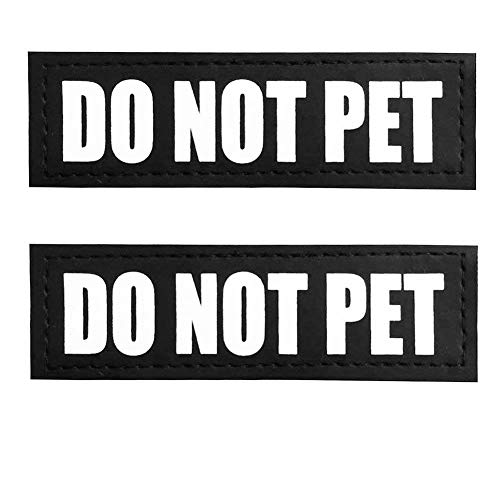
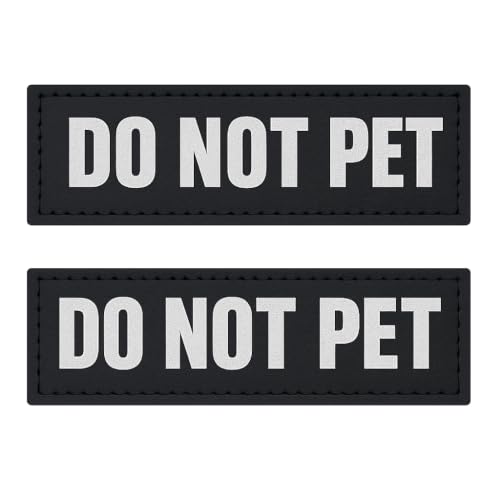
A patch with a clear “DO NOT PET” message tells people not to approach or touch the dog, but it cannot control what people do. A do not pet Velcro patch attaches to compatible hook-and-loop material on a vest, harness, collar, or other gear, depending on the patch design. The message can help make the handler’s request visible during a walk or outing. It isn’t a substitute for managing the dog safely or following the handler’s instructions.
Fit matters because a patch can only communicate well if it stays attached and its message is visible. Check the patch dimensions against the loop panel on the gear, and consider whether the lettering and background will stand out in the conditions where the dog is walked. Some listings describe reflective lettering or other visibility features, but those details vary by patch. For vehicle setup, a patch is separate from restraint equipment; our guide to dog car harnesses covers that distinct travel consideration.






How a do not pet Velcro patch communicates a boundary
A “DO NOT PET” patch is a visible request for people to give the dog space. Hook-and-loop backing lets a handler attach or remove the patch on compatible gear, but the wording alone doesn’t ensure that others will notice or follow it. Its usefulness depends on a suitable attachment surface, readable placement, and the handler’s broader approach to managing interactions. Treat it as a communication aid, not a restraint or guarantee of behavior.
Start by checking the gear’s panel and the patch’s stated size. The product listings supplied for this article include patches in several dimensions, with some descriptions specifying a patch around 6 by 2 inches and others giving smaller measurements. Those are examples of listed product dimensions, not a universal standard. A patch that is too large for a panel may overhang, while one that is too small may leave the message less prominent.
Check these details before settling on a patch and its placement:
- Measure the loop panel’s usable length and width, not just the overall vest or harness.
- Compare those measurements with the patch size stated in its product description.
- Confirm the gear actually has a compatible loop surface where the message will be visible.
- Check whether the patch has hook backing or requires a separate loop panel.
- Consider whether straps, seams, or folds could cover part of the wording.
- Read the listed care information before washing the patch or the gear together.
Hook-and-loop attachment depends on the gear
Hook-and-loop fastening uses two complementary surfaces: hooks on one side and loops on the other. Many patches in the supplied product details are described as having hook backing, so they need a compatible loop surface on the dog’s equipment. A patch may be removable and interchangeable, but that description doesn’t mean it will attach to every fabric, collar, or harness. Confirm the backing and receiving surface before relying on the patch for a particular setup.
Product descriptions may also mention a separate loop piece or an option to sew loop material onto gear. That can make placement more flexible, but only if the patch and added material are compatible and the gear can accept that change. Don’t assume adhesive backing is appropriate for every textile or that it will remain attached through every condition. Follow the maker’s directions, and avoid altering any safety-related equipment in a way that could interfere with its intended function.
Look at the patch while the dog is wearing the equipment, rather than judging placement only when the gear is laid flat. A strap or the dog’s posture may obscure a message that seemed clear on a table. The handler should still be able to see whether the patch has shifted or come loose. Recheck it as part of ordinary gear checks, particularly after taking the equipment on or off.
Size and placement affect how readily people can read it
Patch dimensions, letter size, contrast, and position all affect readability. Some listed designs use light lettering on a dark background, while others describe reflective text or a brighter background. Those are different design approaches, and a feature named in a listing should not be treated as a promise that the message will be visible in every setting. Check the actual product description and consider the lighting and distance at which people are likely to see the patch.
A larger patch may suit a larger panel, but size alone doesn’t settle the choice. A smaller dog’s vest or harness may have limited space, and a patch that crowds straps or curves around the body could be harder to read. Conversely, a very small message can be difficult to notice from a distance. Measuring first helps narrow the options without assuming that a particular size works for every dog or piece of gear.
Place the message where it can be seen without covering a buckle, adjustment point, or other functional feature. Keep the patch away from areas that rub heavily or fold during normal movement when the gear design allows. The right location depends on the equipment’s shape and the dog’s movement, so inspect the fit while the dog is supervised. If a patch shifts, curls, or blocks a functional part, remove it and reassess the placement.
Reflective and glow descriptions are not interchangeable
Some product listings describe reflective lettering or reflective fabric, while others use wording such as “glow in the dark.” These terms describe different features, so read the item details instead of treating them as equivalent. The supplied details include examples of both approaches, as well as patches without a listed visibility feature. A visibility detail may be relevant for low-light walks, but it doesn’t replace appropriate lighting, supervision, or other precautions.
Reflective material is intended to return light toward its source, whereas a glow-in-the-dark claim describes material that emits a glow after exposure to light. The product description is the available source for identifying which feature a patch claims to have. Don’t infer a brightness level, viewing distance, or duration from the label alone. If low-light visibility is a priority, check the specific wording and use other suitable visibility measures as needed.
Choose wording that matches the message you need to convey
A patch should communicate a clear, accurate request. The supplied listings include designs with “DO NOT PET” wording and other messages such as “IN TRAINING” or “SERVICE DOG.” These messages aren’t interchangeable, so verify the exact text before ordering. Avoid using a label that misrepresents the dog’s status or the handler’s intended message.
Some sets provide multiple message options or multiple patches, which may be useful when a handler needs to label more than one compatible item. Other listings describe interchangeable patches, allowing a message to be changed without replacing the entire piece of gear. Read the description carefully to see which messages and backing materials are actually included. Don’t assume that a product photo or general title confirms the wording of every patch in a set.
Use these checks to verify the message and fit before attaching the patch:
- Confirm that the printed words match the request you intend other people to see.
- Check the listing for the number of patches and the messages included in the package.
- Match the patch backing to the receiving surface on the intended gear.
- Look for the stated material, dimensions, and any listed visibility feature.
- Make sure the attachment won’t obstruct adjustment straps, closures, or other gear functions.
- Recheck the patch after attachment to confirm that the full message remains visible.
Understand what a patch can and cannot do
A written boundary can help communicate a handler’s preference, but it cannot make other people comply. Keep the dog under appropriate control and manage distance from people in a way that suits the situation. A patch does not prevent contact, stop pulling, or replace training or other equipment. Avoid relying on any accessory as a guarantee against a dog escaping or someone approaching.
The message is also not a substitute for conversation when clarification is needed. A person may not see the patch, understand its wording, or respond as expected. The handler remains responsible for decisions about interactions and for supervising the dog. If the dog’s needs call for a specific handling plan, rely on that plan rather than expecting a label to manage the encounter.
Keep the patch separate from equipment used for restraint or transport. A patch is an identification accessory, not a leash, harness, vehicle restraint, or safety attachment. For vehicle travel, check the intended use and directions for the actual restraint system; a patch cannot make an unsuitable setup safe. Our information on dog harness fit considerations may also help explain why harness suitability depends on the dog and equipment, not on an added label.
Care and inspection help catch attachment problems
Hook-and-loop surfaces can collect lint, hair, and debris, which may interfere with how well the surfaces engage. Inspect the backing and receiving panel when checking the gear, and follow the product’s care directions for cleaning. Avoid assuming that a patch described as water-resistant or weatherproof has the same care needs as the harness or vest. Product materials and care instructions can vary, so the listing or manufacturer guidance should take precedence.
Check for fraying, peeling, worn hook material, damaged stitching, and printing that has become difficult to read. A removable design is convenient for switching or washing gear, but repeated removal can still make inspection worthwhile. If the patch no longer stays attached or its wording is obscured, don’t rely on it to communicate the request. Replace it or use another suitable way to make the message clear.
For puppies and growing dogs, reassess both the equipment and patch placement as the dog’s gear changes. A patch that fit one vest may not fit the next, even if the new gear serves the same purpose. Measure the new panel rather than assuming the old patch size will transfer. This small check avoids a mismatch and helps keep the wording positioned where it can be seen.
Use product details to make a practical choice
Compare the stated dimensions, attachment style, material, wording, and visibility claims against the gear and conditions you have in mind. A two-patch set may be useful when the same message is wanted on more than one compatible item, while a multi-message set may offer different labels. Those package descriptions don’t establish that every patch will suit every panel. Check each item’s dimensions and the exact contents before deciding.
Brand names and product titles alone aren’t enough to confirm fit or function. Read the individual specifications, especially if a listing offers multiple sizes or message variations. The listed details for the products covered here vary in dimensions, materials, colors, and visibility wording. When a specification is missing or unclear, contact the seller or manufacturer rather than guessing.
Before each outing, confirm that the message is correct, the patch is attached to compatible material, and the text is not hidden. Keep managing the dog’s space and interactions directly, since a patch communicates a request but cannot enforce it. If the attachment or wording is uncertain, resolve that issue before relying on the patch as a visible signal.




Write Your Review
No reviews yet. Be the first to share your experience!